“There have been numerous technical and creative leaps in VFX and filmmaking, but which two are the most significant? How and why are they paradigm shifts in the way we work?”
Nowadays, there are numerous blockbusters in the film industry which clearly make use of VFX. But visual effects were not born with action movies and computers, is something that existed in the early cinema, even if they are not usually recognized as visual effects.
Consequently, it would be really interesting to study the development and changes in the way of doing VFX, in order to see the clear development, understand better the contemporary workflows, and predict the new ones that may exist.
There have been quite a lot of changes in the way of making movies, but if we need to highlight the two most significant ones, there would be the jump between the analog and the digital, and the emergence of the Computer Generated Images.
1 | The jump between the analog and the digital
Since the origins of the cinema, filmmakers tried to invent and develop different ways to create visual tricks. In this way, they tried to make the audience think that some things are real, while they are not.
We can see this scene of The Hounted House by Segundo de Chomón (1907), in which he makes us think that a ghost is cutting the food by using stop motion animation.

We can not speak of analogical VFX without mentioning George Méliés, the Father of Special Effects. He was a magician before being a filmmaker, and he started to do movies exploring the potential of this new tool. He understood the cinema language and he used his ingenuity, and during his career he experimented with a lot of techniques substitution splices, multiple exposures, time-lapse photography, dissolves, or hand-painted colour...

He also improved the technique of Matte shot, which consist in partially cover the camera lens with black-painted glasses, so it does not record any image in that part of the frame. Then, he could rewind the film and shoot again, covering the other part of the lens which was already exposed. In this way, he could have two actions happening in the same scene which could not have happen by recording it in one single shot.
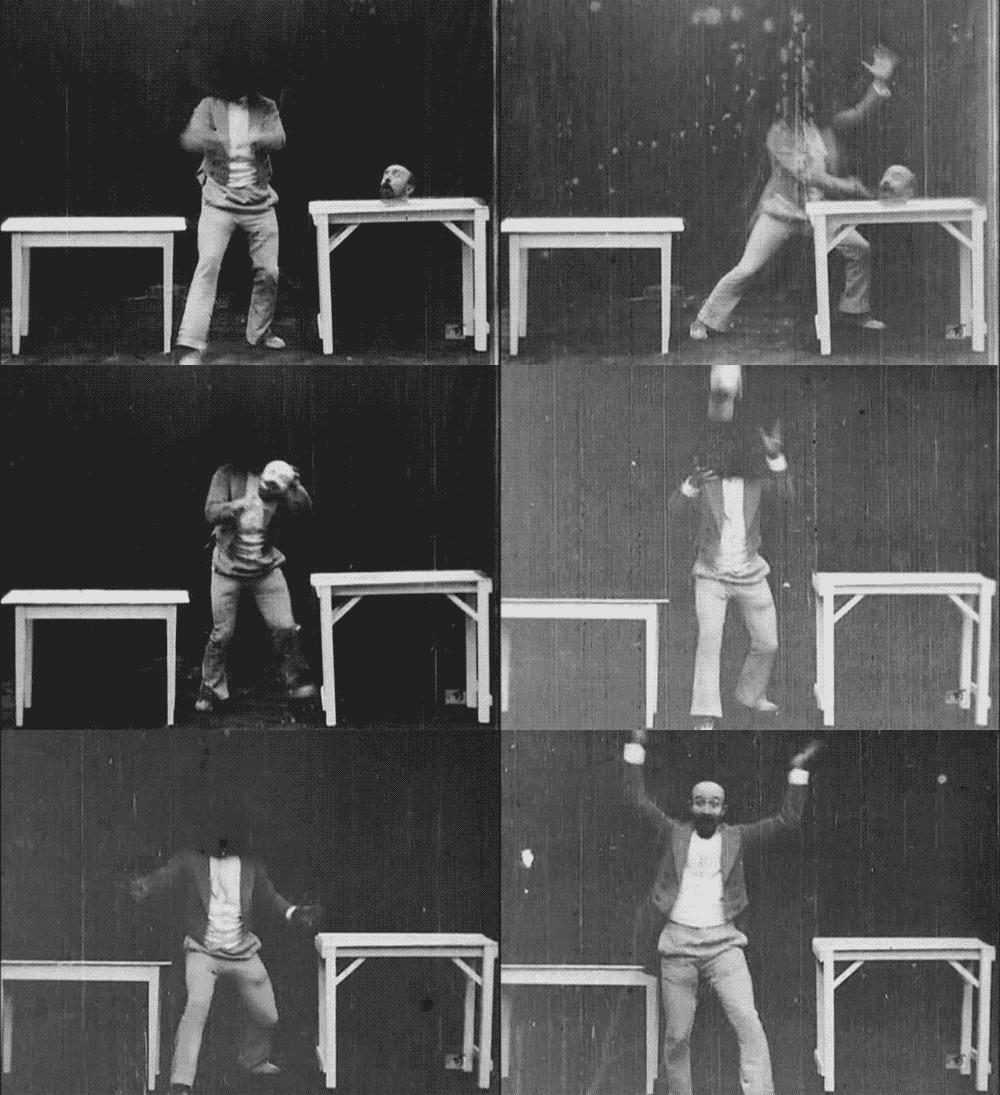
This is the reason why he is called the father of VFX. The principle fo the tecknique of matte shot is the same that we use nowasays doen masks or chromas: the integration of an element in certain part of the frame.
Another commonly used technique is the matte painting over a glass. It consisted in painting part of a shot over a glass and place it in front of the camera covering a place of the shot. It could be used to fill backgrounds or adding elements in the foreground. It coud be made in situ during the same shooting, or afterwards, combining the matte painting with the matte shot techniques. For that, the area in which the matte painting had to ble placed would be painted in black, and then the painting would be overlayed in a second exposition in the studio.
This masks only worked with a still camera, so the filmmakers started to research other techniques in order to be able to do this technique with moving shots. The first method was created by Frank Williams and it is so-called the Williams process. It consisted in recording the actors over a totally black background. After revealing the movie, they would make a copy increasing the contrast. In this way, the action of the character should be registered as a white silhouette over a black background. Then, that would be use as a matte shot, recording the background footage with that white silhouette over it. Finally, both shots would be mixed in order to place the normal image of the actor over the masked background, having this result.
This technique is also used in the movie The invisible man by James Whale, in which the actor is covered by a tight suit of black cloth under the clothes of his character.
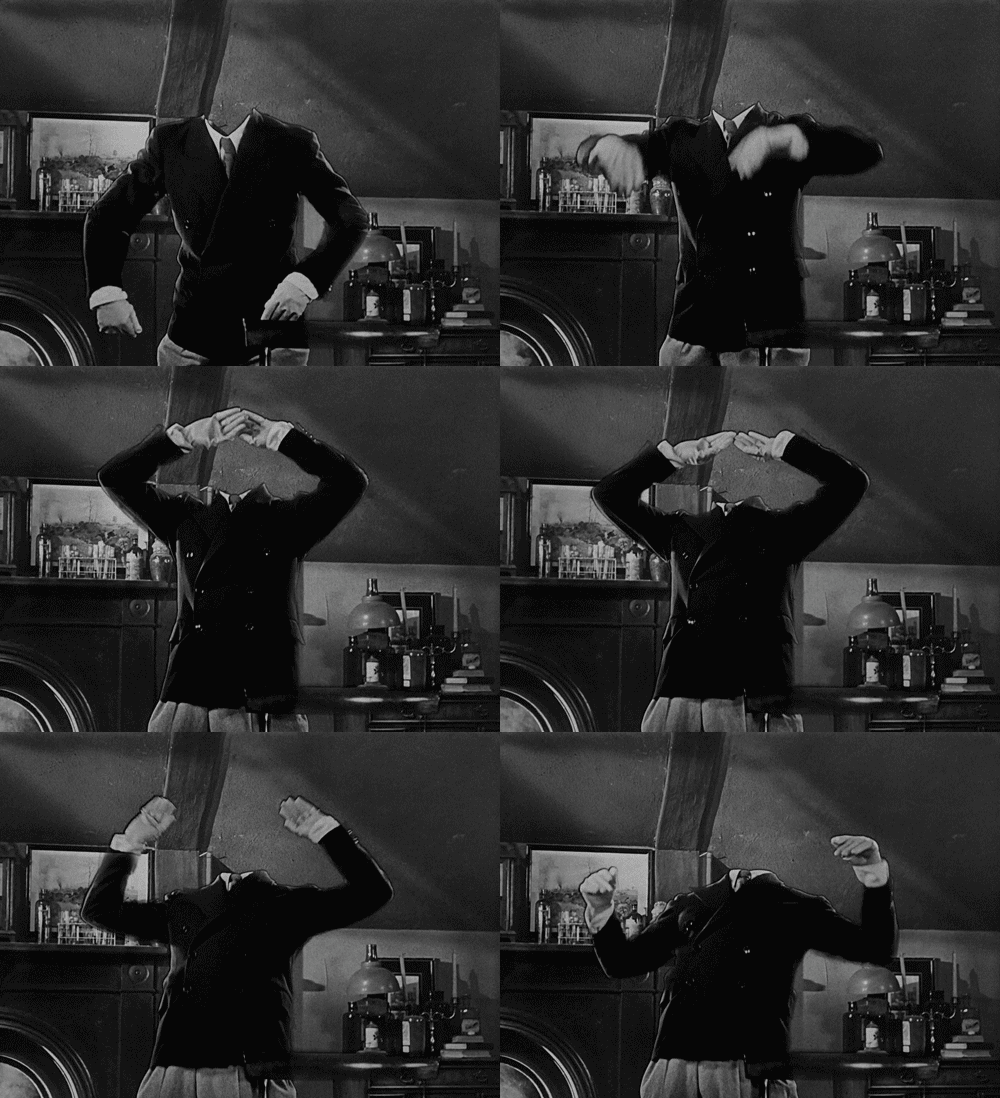
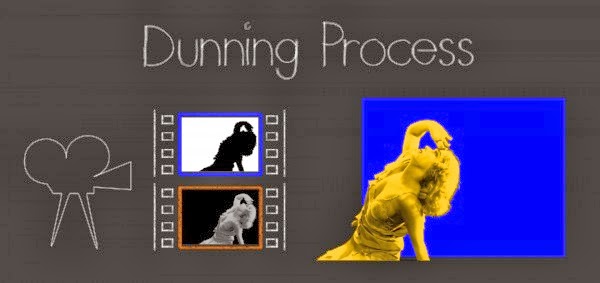
Therefore, we can recognize that the first chroma color is black. But the problem of this kind of mask is that the shadow that the actors projected in the mask were not registered. Therefore, they started tu use a blue background to make the croma. It was called the Dunning procedure, and it consisted in using colored light: blue for the bg and yellow for the actor. Then, using tint and filters they could separate both colored zones in different layers.
But they had to invent new techniques after the color films. They developed a prism which would separate the three colors in three different films, and they used blue as the mask since it is the color which is less near to the skin tone.
Finally, when we came into the digital times, they still using the blue. But with time they started using the green because it is easier to illuminate, it is more different from the sky so it is better for outside shots, it is less common in dressing, and because it generates less noise since the digital sensor has the double of green cells.
As we can see, most of the effects that we use nowadays were invented in the analogical filmmaking. Cutting the negative is transformed in roto, mattes are transformed in keying, double exposure is overlaying, etc…
2 | The jump between digital and virtual
The virtual production permits generate a whole scene and environment in a studio with synthetic elements, having the same resilt as doing with actors and a real location, but being cheaper.
This techniques are usefil to visualize that footage which is impossible to record in real life, and it is commonly used in live-action films.
With this tool we can see the footage in real time, becuase the camera can compose, track and key the elements almost in real time. This would help them to have an idea of how the final shot will look like. It also helps us to change the final result in a quick way, by using real-time rendering engines, commonly used in videogames.
Avater is one of the first films using virtual production techniques, and that is the reason why it meant a huge leap in filmmaking.


