In order to find an interesting topic for my research, I divide the topics in two groups. The first group will include all the topics that are in my comfort zone, which means that I have a basic knowledge about the topic and a defined starting point. The second group will include all those topics which are unknown for me, so the research will practically start from zero, but it will open my mind into unknown fields.
Comfort zone topics
1 | Filmic narrative in Akira Kurosawa
Akira Kurosawa is well-known as one of the best filmmakers in film history. He has not only the skill to choose good stories to tell, but he also knows exactly how to tell it. The key of his good story telling is not only based in the script, but in the rhythm of the movie. His movies are quite complex to analyze. Consequently, we can find a couple of interesting features in his movie production:
- The movement: Movement is an important element for Kurosawa in the composition of the frames and the rhythm of the movie. He always manages to keep the attention of the audience by a really dynamic composition within each scene. One of his most used resources is the weather: when the action of the characters is quite static, he uses the weather in order to create the movement atmosphere he is looking for: rain, fog, fire, and even snow. We can see an example of the use of the rain in the following pictures. The first picture belongs to Rashomon, in this scene, the rain is used to do the image more visual interesting, while the camera, the stage (the house), and the action of the characters remains still. In the picture below we see a scene of The seven samurai in which Kurosawa uses the rain to intensify the movement that it actually exist in the scene and also to create a much more dramatic atmosphere.
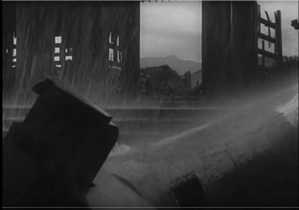
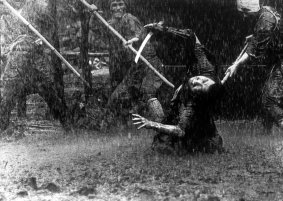
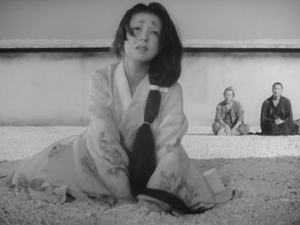
When the action fo the characters has more importance, Kurosawa tent to fill all the frame with their exaggerated and expressive movements, like in the following scene belonging to Rashomon.
Of course, another obvious movement in cinema language is the same camera movement. The camera movements of Kurosawa are really sophisticated. He does not limit himself into the common standards camera movements, but he usually uses the camera as a dancer which plays around with the character to give the best perspective of the action. The camera movements seem accurately thought in order to express the mood of the action and the character in the most effective way. They are always made with a reason and structure: you can always find the beginning, the middle, and the end.
Considering this, it is easy to conclude that the absence of movement is also significant. We can find quite sill frames in his movies. The reason? In my opinion, the editing.
- The editing: For Kurosawa, the film editing has a lot of importance. In fact, he used to be his own editor, which makes the editing quite interesting. Therefore, we can see in his movies a really accurate editing, really integrated in the full idea of the movie itself. Every shot is thought to fit perfectly before the one that follows it. Following the line of the movement, Kurosawa uses still scenes to calm the rhythm of the narration, and after he breaks it with a totally different scene full of movement to caught the attention at once. Which means that the rhythm of the movie has a lot to do with his editing, using it as a narrative tool at the same time. Also, when he wants to keep the editing invisible, he uses a very personal resource: cutting in the movement. Usually, when a scene changes, it is marking the end of an action (or a point of interest) and the beginning of the other. Kurosawa, usually cuts in the action instead. Therefore, the audience is spotting the movement of an actor and when it changes the shot, they still spot the same movement, so the change of view is not that obvious. And then another character takes the action from that perspective in a really natural way. In conclusion, during the whole production of preproduction of his movies, the editing is thought as a basic narrative element. When Kurosawa is shooting a scene it seems he knows perfectly when the scene is going to end and what is exactly coming after it. In fact, Kurosawa does a really accurate and special work of preproduction.
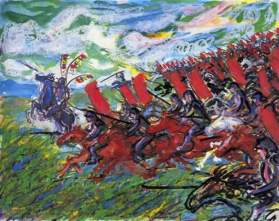
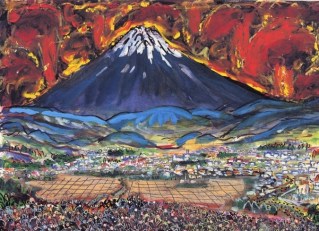
- The pre-production: The genius work of Kurosawa starts from the really beginning. Kurosawa is famous for his artistic storyboards, as shown in the pictures below. As we can see, Kurosawa used to draw full canvas paintings in order to create his story board. He stated that the reason was because in this way he could see better not only the composition, but also the feelings and the mood of each character. Therefore, he would be more able to choose better all the cinema language who needed to come along in order to express that in the best possible way.
2 | The thin line between fiction and reality in Michael Haneke movies
Michael Haneke tries to attempt the inner psychological world of the audience with his movies. In order to reach this goal, he has a really interesting approach in his story telling to make his movies as much realistic and personal as possible. There are some obvious features that he uses in order to achieve this reality:
- The non- defined characters: In most of the conventional movies, characters are really well-developed and defined as one of the main factors of understanding and developing the story. In Michael Haneke movies, the characters are totally subordinated by the situations. In fact, their movies begin straight with the action. No background or psychological development is made before in his characters. Therefore, the psychology of the characters is unconsciously developed by the own spectator. We assume that the spectator is not a story developer, which means that the character that he imagines has a lot to do with his own psychology or the psychology of the people in his close surroundings. Therefore, the constructed psychology of the character will be much closer to the spectator than any other character which is constructed in advance. This makes the movie much more effective, in a sense that the spectator would feel that he understands the character. Moreover, the characters of Michael Haneke are exposed to extreme situations, in which they develop common human traumas in a hyperbolic way. In this way, the spectator is more likely to feel much more empathy with the characters, justify and understand their actions as logical and even imagine themselves in those situations in an unconscious way. This feature is highly effective in his goal to introduce the viewers in the movie and hit deeply in their psychology.
- The genre: Michael Haneke does not follow a structure of genre on his movies. The movie itself seems always unpredictable, as it is the real life. He wants to detach the viewer from the fiction and offer them an experience which can not be identified with any set scheme but the real life, but always through fiction. The main feature that detach the spectator from a realistic life experience is the extremism and brutality of the reality itself.
- The cinematographic tools: The film language is strategically used in order to play with the feelings of the viewer. Se can see a clear example in the violent scenes on Funny Games or The Piano Teacher. For example, (SPOILER) in The Piano Teacher we see a scene of a ‘raping’. The raping itself is shooted in a really long sequence shot that has movement at the beginning but become static when as the raping begins. The sequence shot approaches the viewer to reality, as this is the way in which we see the real life and it feels we are seeing it in first hand, moving around the room and sitting while the raping is taking place. Therefore, when the camera stays still it creates a feeling of cruelty in the viewer which, highly emphatic with both characters, feels the impotence of viewing the scene with no chance to react and help the woman, and at the same time he understands the acts of the man because of his less defined psychology and the situation he has been exposed. This feelings might change in every viewer, but the thing that all of them have in common is that it generates a pretty real experience in themselves viewing the scene. After that, the sequence shot ends and it is replaced by continuous changes of short shots, taking the action from radically different perspectives. In this way, Haneke throws the viewer back to the fiction dimension, reminding that he is watching just a movie, but leaves an interesting reflection to the viewer.
3 | Peter Greenaway’s mise en scene
Peter Greenaway has a very unusual and personal approach in the conception of the colors, the space and the atmosphere. He is a huge art lover, and also a painter, so we can find in and all of his movies the aesthetic of painting guidelines, mainly the baroque and renaissance. He does a lot of work with the position of the characters, the costumes, the ambient, and the lighting. Most of his movies are conceived in a really theatrical way: he often uses general shots, in which we can see the whole scene and we can choose where to look. Usually, he moves the camera in travelling to change from a scene to the other one, as if it was a theater change of stage. There are quite a few interesting main points in Greenaways scenography:
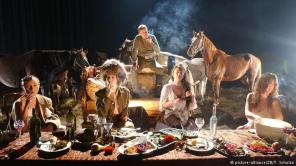
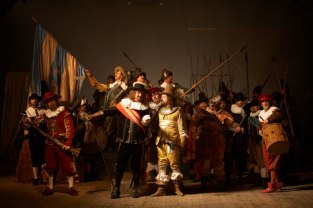
- Theatrical lighting: Greenaaway makes a really interesting une of the lighting in order to create the atmosphere in his movies. Influenced by the Baroque paintings, he tents to create big contrast in their scenes, translating in cinema the technique of chiaroscuro. This helps him to make his compositions more interesting, playing not only with the light but also with the shadows. Usually, his compositions are quire horror vacui, this is also a baroque technique which consist in filling the entire space with elements. He ususally add some moving elements like smoke, which are really interesting in reaction with the light, and helps him to break the static compositions and fulfill the empty spaces. Here we have two examples of one of his most theatrical movies, Nightwatching. This movie showcases the life of the paintor Rembrandt, therefore the painting aesthetic is much more exagerated.
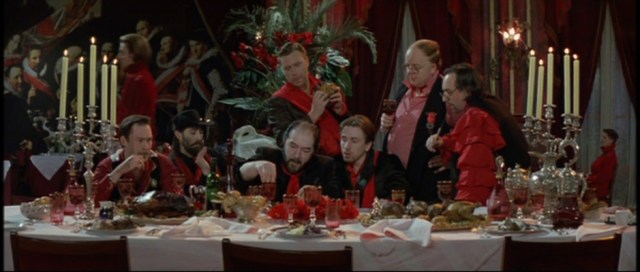
- Colors: Along with the lighting, Greenaway gives a lot of importance to the color. He changes his color palette really accurately depending of each scene and movie, with a general predomination of bright colors. In his movie The cook, the thief, his wife, and her lover he does a really interesting experiment with the colors. Almost all the movie is settled in the same restaurant, in which every room has it´s own color. When the characters go from one room to the other, the color of the walls, the lighting, and even the dress of the same character, changes color. The outside is blue, the kirchen is green, the restaurant is red and the toilet is white. It goes along with all the actions that occur in every different room. In this short scene we can see this change. Also, we can see the travelling and panning camera movements that were mentioned, the theatrical lighting, and the artistic composition, which is developed in the following point.
- Artistic composition: The decorations of the stages of Peter Greenaway are visually complex. When the camera moves around the place we can see a lot of interesting elements which remind us to the still nature of the baroque paintings -we can see a clear example in the video below, when they move from the dining room to the kitchen, a lot of food compositions pass by between the camera and the characters-. Furthermore, all the elements within the frame are arranged in a really balanced way. The image is totally uniform and the characters are well located thoughtfully as it was a canvas.
4 | The Nouvelle Vage and the breaking of cinematographic conventions
By 1950’s the cinema schemes were enough developed. There was a way to do the things and what kind of things to do. And once there are rules, there is the opportunity to brake them. By the late 50’s a group of french cinematographers decided to break the bollocks of the film structure, encouraging the freedom of speech and techniques in film production. Consequently, we can find in this movies radical experiments with editing, narrative and visual style, all of which break with the conservative existing paradigm. The most exciting feature of the French New Wave is that it actually works. They were able to create different structures of communication which actually worked in a totally unpredictable way. Furthermore, those movies were made with lower budget than the commercial ones, so they are nearer to a ‘pure’ way to do cinema. Direct sound recording, low and natural lighting, fragmented and discontinuous editing, long takes, off voice narration. Also the plots itself were uncommon, they usually combined the objective and subjective opinion of the reality, leaving an open conclusion in contrast to the conventional movies which had a structured meaning and goal. They were the one of the firsts that conceived the cinema as a way of sending questions instead of answers.
The study of their schemes and the way they break the cinema laws could be quite interesting, in one side to analyze the traditional film structures in order to know that they exist and how they work, and at the same time how to do a reinterpretation of them and push them into another level which works in a more artistic and experimental way. Also, it is a good example of how to make a totally new content using the conventions as a starting point. François Truffaut, Jean-Luc Godard or Agnes Varda are one of the main filmmakers which would be interesting to analyze.
5 | Analysis of the latest VFX in contrast with the analogical visual effects
During the history of cinema there have been quite an interesting movies in which they managed to do special effects in analogical film. We can find several VFX in old movies and not even notice them, as is the case of Charlie Chaplin. We can see in this video a breakdown of few effects made in analogical movies. Now, those effects can be easily done with rotoscopy, layering, or keying. Besides the little effects in this movies, we can find some other experimental films in which the visual effects were the main topic. One of the gratest examples is Man with a Movie Camera (1929), which is notorious for the range of cinematic techniques that Dziga Vertov, the director, invented or developed, such as double exposure, fast motion, slow motion, freeze frames, match cuts, jump cuts, split screens, Dutch angles, extreme close-ups, tracking shots, reversed footage, stop motion animations, split-screens… This movie is thought as a documentary, but there are another experimental movies which used VFX along to narrate a story. THis is the example of Daisies (1966) by Věra Chytilová, which also makes a massive use of VFX during the movie, as we can see in this scene.
We can see that the treatment and techniques of digital photography and cinema has a lot to do with the analogical process. As we can understand much better the Photoshop functionality by knowing how a dark room works, we should also be able to understand better how and why the digital visual effects are conceived nowadays by analyzing the visual effects prom the past. The film industry is all about growing, and the better we know the basis, the better way we will grow.
No comfort zone topics
1 | Analysis of the series structure: Why are they catchy?
Nowadays the most consumed audiovisual long-time products are series rather than movies. It is obvious the success of platforms as Netflix or Amazon Video which offer this kind of products. Therefore, this tv shows and formats got the key of catch the audience interest. It would be interesting to analyze the the narrative structure of story telling of each chapter, and see the patterns of rhythm and suspense to get to know the strategy of their success.
2 | Short format story telling – Video clips
At first, the video clips were conceived as a recorded video of the singer performing and dancing the song. Nowadays, video clips had become a really powerful way of distributing audiovisual content. Many artist and video clips director started conceiving video clips as short movies itself, going along with the rhythm and message of the song but having their own narrative structures. As a result, we have a really powerful content which give us a message and tell us a story in around 5 minutes. Taking in consideration this short amount of time, we understand that the strategies used to give the message had to be really accurate and effective, therefore, it is interesting for us to analyze how they give this message and tell us this stories only with images and with no words. Here we have some examples as Michael Kiwanuka – Always Waiting which brings visibility to the abandoned seniors; Indochine – College Boy directed by Xavier Dolan, tells a story about bullying in high schools in a really interesting square format; Mykki Blanco – “High School Never Ends”, which speaks about a love story. As those, there are much more examples to be reviewed, videos which tells an effective story about nowadays issues.
3 | New VFX techniques
As new members of the VFX industry, it would be interesting of analyze and research in deep the latest VFX techniques. This topic could be connected with the analogical techniques -stated before- and do a chronological development comparing the new and the old.


